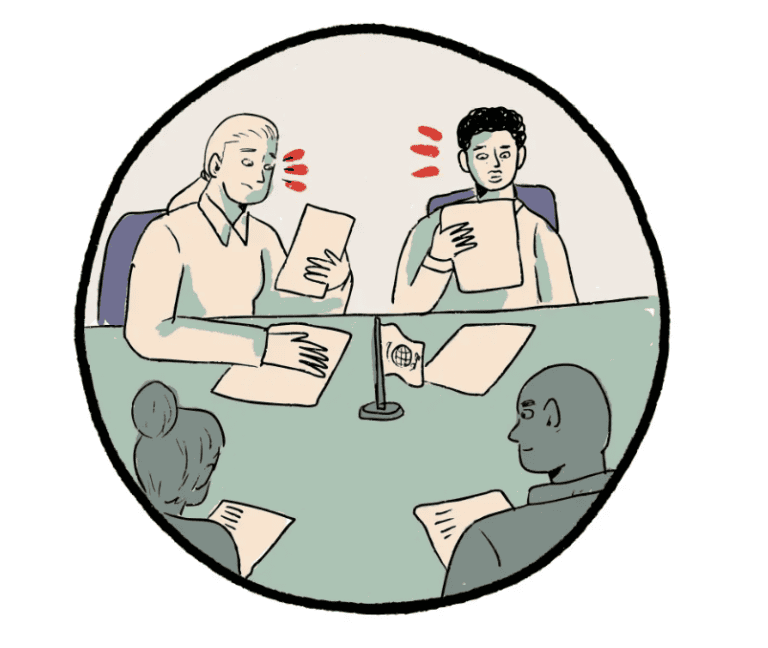
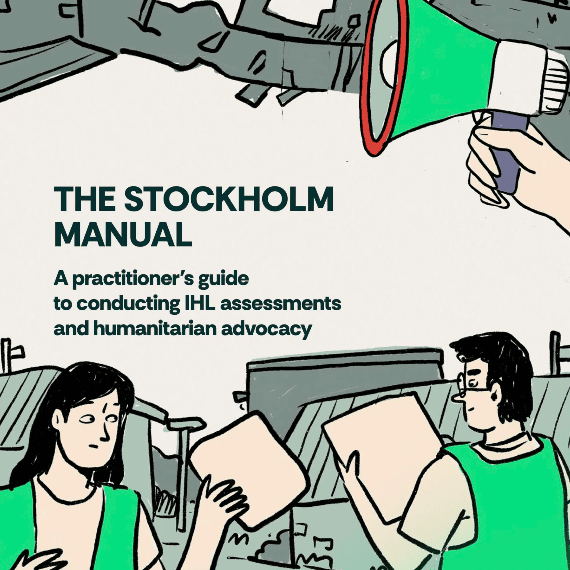
Growing inconsistencies in the application of international humanitarian law (IHL) make the ability to assess whether IHL violations have taken place accurately and act appropriately more important than ever. The IHL Centre has been providing training on the Stockholm Manual to a growing cohort of humanitarian practitioners working in, or supporting operations, in armed conflict-affected settings, including the humanitarian operational and policy leads of ACT Alliance EU and Caritas Europa.
Those engaging with the Manual include civil society organisations, UN agencies and other humanitarian actors. The authors and trainers of the Manual emphasise that it is proving valuable both to organisations using IHL as part of their civilian protection and advocacy work, as well as those who engage with parties to conflict more broadly.
The Manual demonstrates that understanding IHL is valuable even where public criticism is not appropriate. It helps staff to identify protection concerns, engage in fact-based dialogue with relevant stakeholders, and explore a range of advocacy approaches that can ultimately encourage greater compliance with IHL.
Assessing respect with IHL in complex and fast-moving armed conflict settings is often challenging for a whole range of reasons. For example, humanitarian actors are unlikely to have access to all of the information available to parties to the conflict when making targeting decisions and conducting proportionality assessments. Consequently, they may feel less confident speaking out on potential IHL violations. We asked the authors of the Stockholm Manual which aspects of the Manual are having the greatest impact for the work of the practitioners reached. They highlighted three highly valued contributions.
1. No legal expertise required
The Manual helps humanitarian practitioners, who in many cases have a degree of familiarity with IHL, but do not necessarily have legal training, connect with IHL in a way that is both accessible and practical. and therefore easier to apply in practice to the operational contexts in which they work.
Rather than starting with legal provisions, it begins with the humanitarian concerns practitioners most commonly encounter in the field and then walks them through the relevant IHL questions, indicators, and examples of compliance and non-compliance. This helps users to assess situations through an IHL lens, including those without specialist legal expertise or training.
2. Handling humanitarian advocacy on IHL with sensitivity
We’ve also heard that the advocacy guidance in the Manual has been particularly valuable: each chapter contains suggested messaging that practitioners can use to engage effectively in humanitarian advocacy. While organisations naturally adapt the messages to their own context, the Manual provides practical starting points for communicating concerns in a legally accurate and operationally sensitive way.
Several participants have highlighted the usefulness of framing their concerns by clearly restating the applicable IHL rule and the humanitarian consequences, without necessarily alleging that a violation has occurred – an approach that can support constructive and effective engagement in sensitive situations while remaining firmly grounded in the law.
3. Growing reach of accompanying Inclusive IHL guide
The findings and recommendations of the Centre’s Inclusive IHL: Closing the Protection Gaps report –reflecting the work of the IHL Centre’s Expert Group on Inclusion – are garnering huge interest and making a vital contribution to ensuring that humanitarian advocacy is as inclusive as possible:
For many inclusion was limited to children and women – but when we look at the reality of who the civilian population is we see it is of course much more diverse than that – men and boys, older persons, persons with disabilities, ethnic minorities, LGBTQI+ persons to name a few, are all equally protected by existing IHL rules, and impacted differently by the effects of armed conflict. Our job is to ensure that arms bearers, third states, and accountability mechanisms respond to the reality that civilian populations are diverse and ensure that all civilians are equally protected as per the rules of IHL.
The Stockholm Manual and Inclusion Report are crucial tools both for in-country negotiations at the field level, as well as at an international advocacy level. This is especially true as the EU, through its new Joint Communication on Humanitarian Aid, the tools add to vital reference points for applying those commitments in practice. Above all, they provide much-needed avenues for humanitarian stakeholders at all levels to gain accuracy and confidence in navigating sensitive conversations on IHL. They are crucial compasses to overcome gaps in protection and do no harm approaches, and bringing clarity on obligations and the positive commitments to ensuring impartial aid reaches those facing humanitarian needs.